

Direct Child Therapy
Direct therapy sessions at Wind Ridge Speech Pathology are individualized, engaging, and evidence-based, with goals tailored to each child’s strengths, needs, and developmental profile. Services are designed to build meaningful skills that carry into everyday life, with caregiver collaboration as an important part of the process.

Speech and Language Evaluations
Evaluations are designed to provide a comprehensive understanding of your child’s speech, language, and communication skills. Assessments may focus specifically on speech (articulation and sound production), language (understanding and use of language), or a combination of both, depending on your child’s needs. Additional areas such as social communication and early literacy-related skills may also be included when appropriate.
Caregiver input is an important part of the process. Following the evaluation, families receive a detailed summary of findings along with individualized recommendations and, when appropriate, a plan for therapy or support.

Speech Therapy
(Articulation and Motor Speech)
Speech therapy focuses on the development of clear and accurate sound production. This may include support for articulation errors, phonological patterns, or motor-based speech challenges.
Sessions are individualized and use a play-based, evidence-based approach to help children learn how to produce sounds more accurately and consistently. The goal is to improve overall intelligibility and support carryover of skills into everyday communication. Caregivers are regularly included to support practice and consistency outside of sessions.
Often appropriate for children who are difficult to understand, substitute or omit sounds, or have been identified with a speech sound disorder.

Language Therapy
Language therapy focuses on how children understand and use language to communicate. This may include support for vocabulary development, sentence structure, following directions, storytelling, and social communication skills.
Sessions are tailored to each child’s developmental level and are designed to build functional communication skills that can be used across settings. A play-based, evidence-based approach is used, with caregiver involvement to support carryover into daily routines.
Often appropriate for children who are not talking as much as expected, have difficulty expressing themselves, or struggle to understand language.
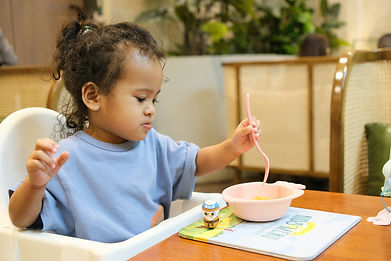
Feeding Therapy
Feeding therapy focuses on the skills involved in eating, including oral motor coordination, sensory responses, and mealtime routines. Services may address concerns such as limited food variety, difficulty advancing textures, or stressful mealtimes.
Intervention is individualized and designed to support safe, functional eating while also considering the overall family experience around meals. Caregivers are included to help create consistency and support progress at home.
Often appropriate for children with picky eating, restricted diets, difficulty chewing or swallowing, or challenges with mealtime routines.

Social Communication Therapy
Support for the communication skills children use to connect with others and navigate social situations successfully.
This may include understanding conversational back-and-forth, initiating and maintaining interactions, interpreting social cues, perspective-taking, problem-solving, flexibility in play, and building peer relationships. Support can also address communication challenges that arise in group settings such as the classroom, playground, or extracurricular activities.
Therapy is individualized and designed to help children feel more confident, connected, and successful in their everyday social world.

Executive Functioning
and School Success
Support for the thinking, language, and self-management skills children rely on for learning and independence.
This may include organization, planning, task initiation, time management, following multi-step directions, completing homework routines, self-monitoring, and managing increasing academic expectations. Support may also address language-based classroom demands such as comprehension, written expression, studying, and verbal problem-solving.
Services are individualized to help children build practical systems, stronger independence, and greater confidence at home and at school.